Home / Case study
Granite Guardian
An open-source judge model for LLM systems. It decides whether a prompt, a response, a retrieved passage or a tool call meets a stated criterion, and it does so fast enough to sit inside an agent loop.
- Role
- Project and training lead
- Current release
- Granite Guardian 4.1 8B, April 2026
- Base model
- Granite 4.1 8B
- License
- Apache 2.0
What it does
A yes/no verdict against a criterion
Every call pairs a conversation with one criterion. The model answers yes or no, and in thinking mode it also writes out its reasoning. The criteria below are built in. Since 4.1, users can also write their own.
Harm
- General harm
- Social bias
- Jailbreaking
- Violence
- Profanity
- Unethical behavior
Retrieval-augmented generation
- Context relevance
- Groundedness
- Answer relevance
Agentic workflows
- Function-call hallucination
Bring your own criteria
- Any rule written in natural language, such as a format, length or domain constraint
Training
What post-training adds
Granite Guardian is fine-tuned from the Granite base model on human-annotated data combined with synthetic data informed by internal red-teaming. Additional synthetic data improves hallucination and jailbreak assessment.
The clearest measure of what training contributes is the comparison with prompting the same base model. On IFEval multi-constraint checks, the base Granite 4.1 8B reaches 0.569 balanced accuracy when prompted as a judge. Granite Guardian 4.1 8B reaches 0.844.
The model runs in two modes. No-think returns the verdict directly for low latency. Think produces a reasoning trace first, for cases where the justification matters more than speed.
Decisions
Three design decisions
A judge, not a classifier
Guardian is fine-tuned to answer with a yes or no token and its probability, instead of a classification head on top of the base model. That kept the whole language model in play. It is what later let 4.1 take criteria it had never seen and serve as a reward model.
Criteria at runtime
4.1 moved from a fixed risk taxonomy to criteria written in the request. Out-of-distribution safety F1 slipped from 0.81 to 0.79; IFEval multi-constraint checking went from 0.458 to 0.844. The trade was the point: a judge that applies the user’s rule beats a classifier that applies ours.
A reasoning mode from the same weights
Think mode writes its justification before the verdict. It costs latency, 59 ms to 1.3 s on the Artificial Analysis benchmark, and buys three things: a justification where one is needed, a way to see why a custom criterion misfires and tighten its wording, and a trace for debugging verdicts in production.
Independent evaluation
Artificial Analysis guardrail benchmark
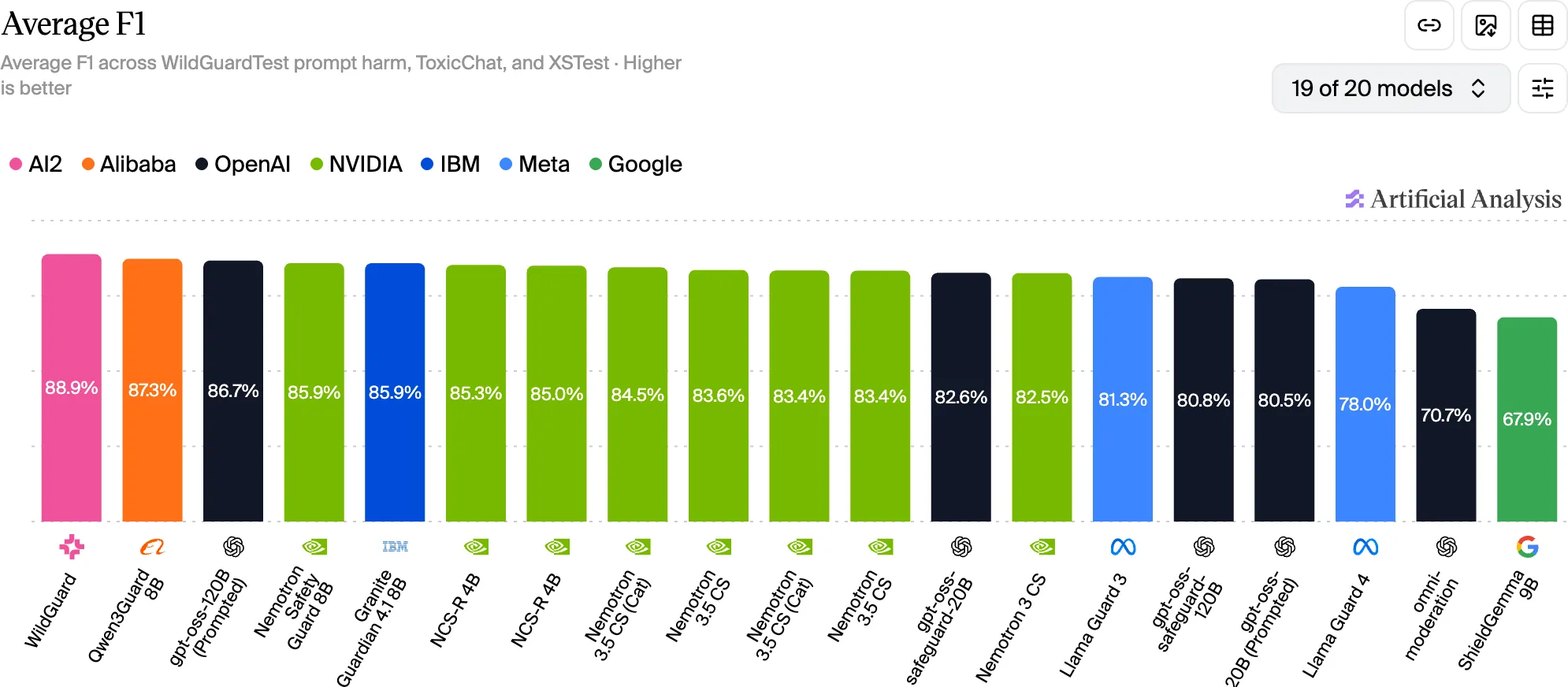
In June 2026 Artificial Analysis, in partnership with NVIDIA, scored twenty guardrail configurations from seven vendors on 7,232 prompts drawn from WildGuardTest, ToxicChat and XSTest. Models that take a policy at runtime, Granite Guardian among them, were all given the same broad safety policy, written by Artificial Analysis and not tuned per dataset.
- Average F1
- 0.859
- Fifth of 20, within 0.03 of the leader
- Among policy-at-runtime models
- First
- Ahead of gpt-oss-safeguard 20B and 120B and ShieldGemma 9B
- Average latency
- 59 ms
- No-think mode
- Benign prompts passed
- 91.4%
- Second among the top five
Thinking mode costs about 1.3 seconds per check and scores 0.832 on F1, below the no-think mode. On this task, thinking adds an explanation but does not improve accuracy.
Beyond safety
From Guardian 3.3 to 4.1
The 4.1 release turned a safety classifier into a general judge. Custom-criteria accuracy rose sharply and tool-call checking improved, while groundedness held level and out-of-distribution safety dipped slightly.
Balanced accuracy by benchmark
Custom criteria, tool calls and RAG groundedness. Both versions in no-think mode.
- Granite Guardian 3.3 8B
- Granite Guardian 4.1 8B
- IFEval multi-constraint0.4580.844
- InfoBench, human-annotated0.5350.706
- InfoBench, GPT-4-annotated0.5850.726
- FC Reward Bench0.740.79
- LLM-AggreFact average0.761 → 0.760
| Capability and benchmark | Measure | 3.3 8B | 4.1 8B |
|---|---|---|---|
| Custom criteria: IFEval multi-constraint | balanced accuracy | 0.458 | 0.844 |
| Custom criteria: InfoBench, human-annotated | balanced accuracy | 0.535 | 0.706 |
| Custom criteria: InfoBench, GPT-4-annotated | balanced accuracy | 0.585 | 0.726 |
| Function-call hallucination: FC Reward Bench | balanced accuracy | 0.74 | 0.79 |
| RAG groundedness: LLM-AggreFact average | balanced accuracy | 0.761 | 0.760 |
| Out-of-distribution safety: aggregate | F1 | 0.81 | 0.79 |
Both versions in no-think mode. Source: Granite Guardian 4.1 8B model card.
As a reward model
The same verdicts can rank candidate responses. On the verifiable tasks in the JETTS benchmark, which cover math, code and instruction following, Granite Guardian 4.1 8B selects better answers than every reward model it was compared with.
| Reward model | JETTS overall |
|---|---|
| Granite Guardian 4.1 8B | 70.29 |
| Skywork-Reward 27B | 68.67 |
| Skywork-Reward 8B | 68.62 |
| SFR-Judge 70B | 68.22 |
| OffsetBias 8B | 67.99 |
Best-of-N selection, no-think mode. An oracle selector scores 81.54.
Adoption
Public testimonials and adoption
“Granite-Guardian-3.2-5B showed the best generalization with only a 6.5% gap.”
“IBM’s open-source safety models provide harm detection, jailbreak detection, topic control, hallucination detection, and RAG quality assessment, capabilities that other guard providers don’t yet offer.”
- Hugging Face downloads, all time, across the Granite Guardian models and the capability libraries
- 1.16M
- Ollama pulls of granite3-guardian and granite4.1-guardian
- 371K
- community quantized builds on Hugging Face
- 45
- downloads of Granite Guardian 4.1 8B in the past 30 days
- 56K
Counts read on October 1, 2026. More on the home page.
Timeline
Releases and results
- Dec 2024Granite Guardian paper released
- Feb 2025Granite Guardian 3.2 adds smaller 5B and 3B variants
- Apr 2025Six of the top ten places on GuardBench
- 2025Paper published at NAACL 2025, Industry Track
- 2025Granite Guardian 3.3 ranks third of 39 on the LLM-AggreFact leaderboard
- Apr 2026Granite Guardian 4.1 8B: custom criteria, hybrid thinking
- 2026Guardian and Core capability libraries for Granite 4.1
- Jun 2026Top five of 20 on the Artificial Analysis guardrail benchmark